

For football enthusiasts, the year 2026 promises to be nothing short of a dream, as the 2026 FIFA World Cup is set to become the largest World Cup in history. This time around, the tournament will be hosted not by just one but three nations—the United States, Mexico, and Canada. This marks the first time that three countries have collectively undertaken the responsibility of hosting the World Cup. A total of 48 teams will participate in the tournament, with 104 matches scheduled to be played—making it far larger and more spectacular than any previous World Cup.
This event will be more than just a series of matches; it will offer an experience akin to a global festival, where diverse cultures, cities, and stadiums will converge to elevate the celebration of football to new heights. The tournament will kick off on June 11 at the historic Estadio Azteca in Mexico City and will conclude on July 19 with the final match at the New York-New Jersey Stadium.
From Opening to Final: Every Match is a Memorable Occasion
The tournament will commence at the Estadio Azteca, a venue renowned worldwide for its rich history and heritage. This stadium will be hosting the World Cup for the third time—a record in itself. Meanwhile, the final match will be played at MetLife Stadium, located near New York City and equipped with state-of-the-art modern amenities.
Throughout the tournament, players and spectators alike will be treated to an experience that presents a magnificent blend of modern technology and historic stadiums. Some venues will feature high-tech stadiums with retractable roofs, while others will be the hallowed “temples” of football where the echoes of history still resonate today.
The Largest Stadiums: Where the Roar of Hundreds of Thousands Will Resound
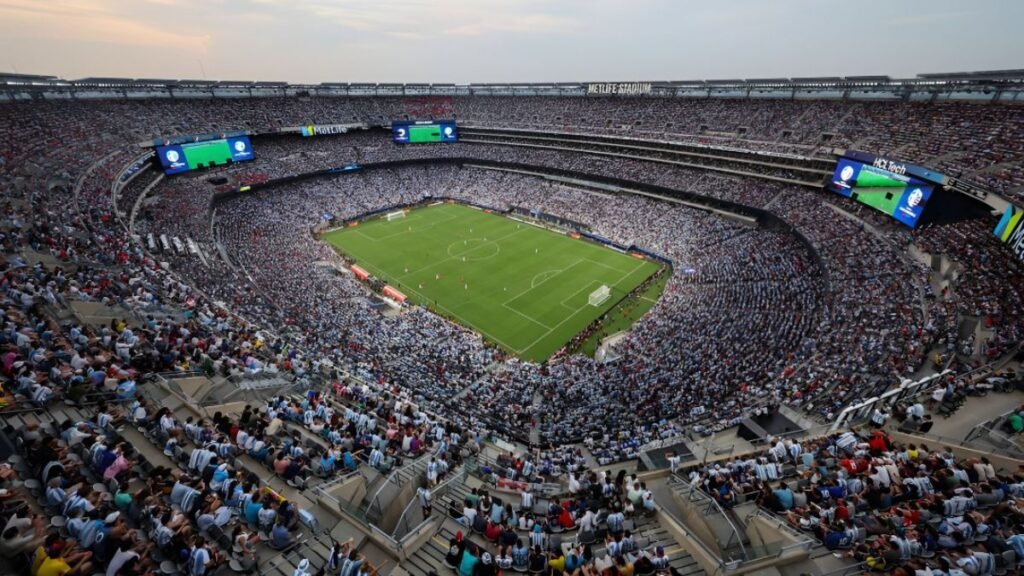
Several stadiums hosting the 2026 World Cup are poised to become major centers of attraction due to their immense capacity and grandeur. Watching a match from the stands of these stadiums promises to be an experience nothing short of a festival.
Topping the list is AT&T Stadium, which boasts a seating capacity of approximately 94,000 spectators. Renowned for its modern design, retractable roof, and electrifying atmosphere, this stadium is set to serve as a key venue for major knockout-stage matches. Next comes the Estadio Azteca, with a capacity of approximately 83,000. This stadium is not merely a playing field but a living symbol of football history—a venue where numerous historic matches have taken place.
The MetLife Stadium, set to host the final match, can accommodate nearly 82,500 spectators, and its location makes it truly unique.
Similarly, the Mercedes-Benz Stadium and Arrowhead Stadium are renowned for their distinctive designs and atmospheres. Arrowhead Stadium, in particular, is globally famous for its incredibly loud and boisterous crowd.
Every City Has Its Own Identity: A Continent-Spanning Celebration of Football
One of the most distinctive features of this World Cup is that its matches will be played across various cities, ensuring a unique experience at every location. From Texas in the U.S. to Vancouver in Canada, each city will infuse the tournament with its own distinct culture and atmosphere.
Stadiums such as NRG Stadium, Levi’s Stadium, and SoFi Stadium stand as prime examples of modern technology and world-class amenities. Meanwhile, venues like Lumen Field and Hard Rock Stadium are celebrated for their magnificent atmospheres and the sheer energy of their crowds.
Canada and Mexico are certainly not to be outdone in this grand event. Stadiums such as BC Place, Estadio BBVA, and Estadio Akron are poised to lend a truly international flair to the tournament.
An Exceptional Experience for Players and Fans Alike
Organized on such a massive scale, this World Cup promises to deliver an extraordinary experience for both players and spectators. The matches have been scheduled across various cities in a manner designed to minimize travel burdens for the teams while ensuring easy accessibility for fans at every venue.
Some matches will be played in high-altitude regions, while others will take place in colder climates—this very diversity will make the tournament even more captivating. Meticulous attention has been paid to the amenities at every stadium to ensure that spectators enjoy a premium experience.
Conclusion: Football’s Grandest Celebration
The 2026 World Cup is destined to be far more than just a sporting event; it is set to become a historic celebration. Bringing together three nations, 16 stadiums, and 48 teams, this tournament will elevate the world of football to an entirely new level. Every city, every stadium, and every match will bear witness to the fact that football is not merely a sport but a force that unites the world. If you become a part of this World Cup—whether in the stadium or on the screen—this experience will remain memorable for you forever.
FAQs
Q. When will the FIFA World Cup 2026 start and end?
A. It will begin on June 11, 2026, and end with the final on July 19, 2026.
Q. Which countries are hosting the 2026 World Cup?
A. The tournament will be hosted by the United States, Mexico, and Canada.
Q. How many teams will participate in the 2026 World Cup?
A. A total of 48 teams will compete, making it the largest World Cup ever.
Q. Where will the final match be played?
A. The final will take place at MetLife Stadium.
Q. What makes the 2026 World Cup unique?
A. It is the first World Cup hosted by three countries and features the highest number of matches and teams in history.
Leave a Reply