
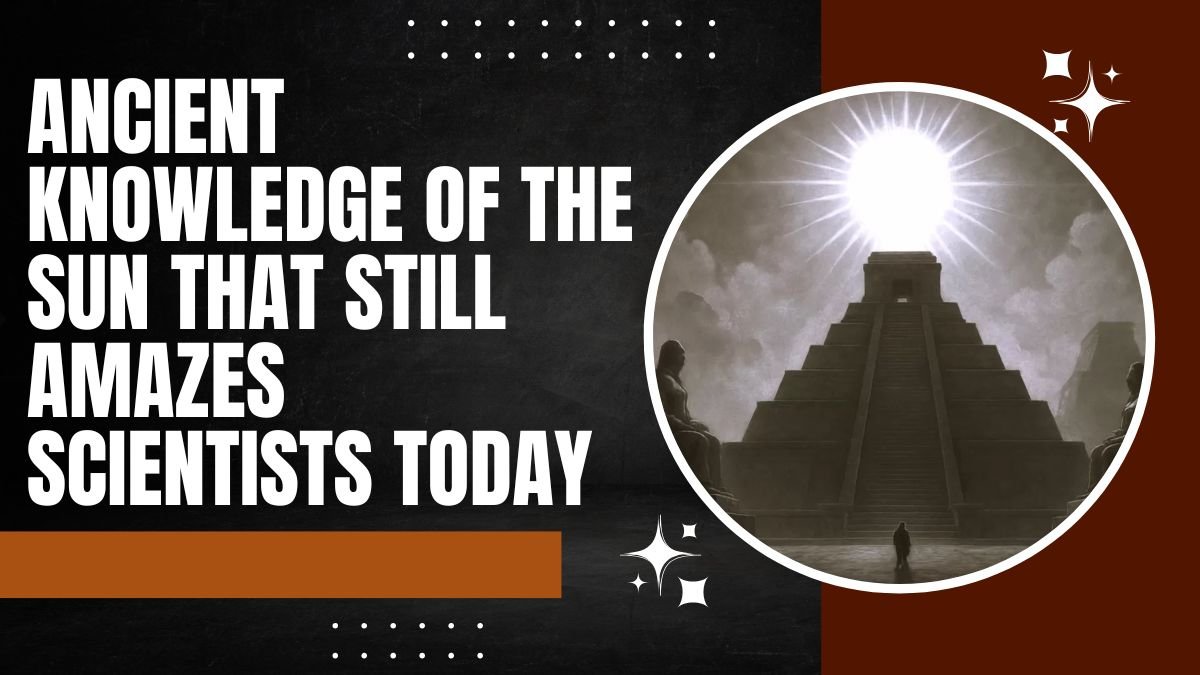
Today, when we see the sunrise and sunset times using mobile apps and satellites, it’s hard to imagine how people thousands of years ago knew all this. But the truth is that ancient civilizations understood the sun so intimately that they captured it in stone. Temples, pyramids, standing stones, and observatories built around the world were not just places of worship but giant astronomical instruments that measured the sun’s daily movement, the changing seasons, and the length of the year.
For them, the sun was not just a star that provided light but the basis of time, life, and agriculture. Therefore, understanding its movement was integral to their very existence.
Sun Movement and the Length of the Year
Countries like India discovered thousands of years ago that the Earth revolves around the sun in a fixed time. Texts like the Surya Siddhanta described the length of the year so precisely that it almost matches today’s scientific data. This was only possible if the sun’s position was observed daily from a fixed location.
This is why many temples and stone structures were built so that the sun’s rays would fall on a specific spot on specific days of the year. This allowed priests and astronomers to know when a new season had arrived or a holy day had begun.
Understanding the Sun as the Center
Some civilizations long ago understood that the sun was the center of the solar system. Scholars like Aryabhata of India and Aristarchus of Greece proposed that the Earth rotated and revolved around the sun. This was before the existence of telescopes.
This knowledge was embodied in stone structures. Temple steps, pillars, and gates were placed so that the sun’s rays would fall directly on certain days of the year. This demonstrates not only astronomical knowledge but also the art of translating it into architecture.
Long-Term Observation of the Sun
In ancient China, India, and Egypt, records of the sun and eclipses were kept for centuries. These records allow scientists to learn how active the sun was and how fast the Earth was rotating thousands of years ago.
Some ancient Chinese texts mention dark spots on the sun, which we now call sunspots. This suggests they were observing not only sunlight but also changes on its surface.
Stone Temples: A Living Calendar
Many of the world’s ancient structures are built in perfect alignment with the sun. Egypt’s Pyramids of Giza face almost exactly north. India’s Konark Sun Temple tells time with its stone wheels, whose shadows can be counted down to minutes. The Modhera Sun Temple captures the first rays of the sun on each equinox.
Europe’s Stonehenge aligns with the sun on the solstice, and America’s Chichen Itza casts a serpentine shadow on the equinox. This was not a coincidence but the result of calculation.
Agriculture, Religion, and Time Alignment
Knowing the sun’s movement wasn’t just a scientific curiosity. These charts determined agriculture, the dates of festivals, and religious rituals. Misreading the sun’s position could lead to crop failure and jeopardize the entire society.
Thus, stone structures were essentially society’s calendar and clock, telling everyone what time of year it was.
Conclusion
Even today, when we look at these ancient structures, it’s clear that they aren’t just beautiful buildings but also a marvelous blend of mathematics, astronomy, and engineering. Our ancestors permanently recorded the sun’s movement in stone. This is why, even thousands of years later, we can still use them to understand time, the seasons, and the universe.
Leave a Reply