
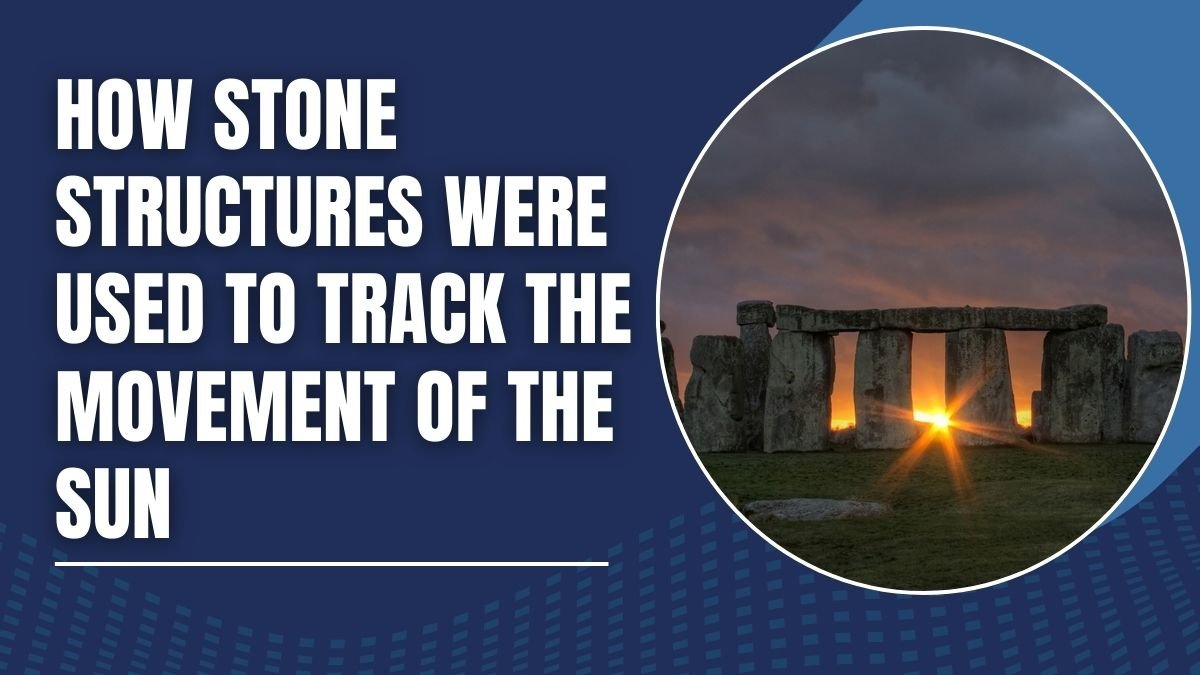
Stone Structures: Today, we can tell the time in seconds by looking at our mobile phones and watches, but thousands of years ago, humans didn’t have such devices. Yet, ancient civilizations knew very well when summer would arrive, when the rains would come, and when it was the right time to harvest crops. This wasn’t mere guesswork but a highly precise science based on the movement of the sun. They translated this science into stone. Stonehenge, the Konark Sun Temple, Machu Picchu, and the Egyptian pyramids were essentially giant stone clocks and calendars that calculated days, months, and years.
The Technique of Measuring Time with the Sun and Shadows
Ancient people knew that the sun rises and sets along a fixed path every day, and the shadows cast by its rays change accordingly. They called this principle gnomonics, which is the art of determining time and seasons from the shadow of an upright object.
Stonehenge in England is a prime example of this technique. On the longest day of summer, the summer solstice, the sun’s rays fall precisely between the main stones. This signified the beginning of a new agricultural cycle. Similarly, the sun’s position was different during the winter solstice, marking the start of the cold season.
In Egypt, near the pyramids of Giza, priests would plant wooden or stone rods and measure their shadows. On the equinox, the shadow was perfectly straight, indicating that day and night were of equal length. This time was chosen to mark the beginning of the new agricultural season.
The Konark Sun Temple: The World’s Most Advanced Stone Clock
The Konark Sun Temple in India showcases the most advanced form of this science. Its massive stone wheels are not merely decorative but are actual sundials. Sunlight falling on the spokes of these wheels casts shadows, allowing the time of day to be determined down to the minute. The small markings on these wheels also provide information about the seasons and months. This means the temple served simultaneously as a clock, a calendar, and an astronomical instrument. Integrating Entire Buildings with the Sun
Some civilizations integrated not just shadows but entire buildings with the movement of the sun. Machu Picchu in Peru is an example. The Intihuatana stone located there aligns perfectly with the sun’s rays during the solstices and equinoxes. The Incas believed this bound the sun’s power to the earth and provided energy for agriculture.
At Chichen Itza in Mexico, the El Castillo pyramid creates a spectacular sight during the equinoxes. Sunlight casts a serpent-like shadow on the steps, symbolizing their deity Kukulcan. This spectacle was not only religious but also served as a marker for the changing seasons.
Combined Knowledge of Stars and the Sun
In some places, the stars were considered alongside the sun. At Nabta Playa in Egypt, stones were arranged so that certain stars, when rising in the morning, would align with these stones. This indicated the arrival of the rainy season and spring. This astronomical calendar was created thousands of years ago.
The Deep Connection Between Agriculture, Religion, and Time
The primary purpose of these structures was agriculture. If crops were not planted at the right time, famine could result. By predicting the seasons based on the sun’s movement, farmers could cultivate their crops at the optimal time. The sun was also considered the source of life. Inti in the Inca civilization, Ra in Egypt, and Surya Deva in India were worshipped. The days determined by these stone calendars were among their most sacred days.
Conclusion
These ancient stone structures prove that humans were scientifically minded thousands of years ago. They understood the movement of the sun, shadows, and the sky, and translated this knowledge into stone. These were not merely temples but the world’s first astronomical observatories. Modern science today stands on the foundation of these ancient discoveries.
Leave a Reply